
EVIDENCE-FIRST RESEARCH

Evidence-locked biology — from variant to validated target

Foundation models, knowledge graphs, and CRISPR feedback loops — chained into reproducible workflows with hash-verified provenance. Every prediction traces to its evidence.

Research motions

Research motions across the stack

Ten motions spanning genetics, functional biology, multi-omics, drug discovery, and translational research — each grounded in the 28 DomainOS catalog and 5 composed reasoning plugins.

Genetics

Rare Disease Diagnostics

End-to-end Mendelian workup from trio sequencing through ACMG-classified reports, grounded in ClinVar evidence and HPO phenotype fit.

  • Trio exome → ranked candidate variants with inheritance fit
  • ACMG classification with conflict-aware ClinVar audit
  • HPO-driven phenotype matching (Exomiser, Phen2Gene)
  • Auto-drafted clinical report with citation trail

Stack

mendel-os · rare-os · clinvar-os · co-writer

Every classification traces to ClinVar submission IDs and cited literature in the manifest.
Genetics

Complex Trait Genetics

Biobank-scale GWAS with calibrated inflation checks, fine-mapping to credible causal variants, and cross-ancestry polygenic risk with bias diagnostics.

  • REGENIE/SAIGE association at biobank scale
  • SuSiE/PolyFun fine-mapping to credible sets
  • Cross-ancestry PRS with calibration + ancestry audit
  • Locus-to-target linkage through knowledge graph

Stack

GWASos · finemap-os · prs-os · knowledge-graph

Summary stats, LD panels, and credible sets hashed into a reproducible manifest.json.

Functional

CRISPR Perturbation Science

Design-to-hit workflows for CRISPR knockout, knockdown, and base-edit screens with HITL gates at guide design, delivery, and hit calling.

  • Tiled guide library design with off-target audit
  • Pooled screen analysis (MAGeCK, drugZ, BAGEL)
  • Evidence-grounded hit triage against paper graph
  • 4 approval gates from design to analysis

Stack

CRISPRos · screen-os · co-scientist · paper-intelligence

Every guide, count, and hit call emits SHA-256-hashed inputs and a decision log.

Functional

Single-Cell & Spatial Atlases

Reproducible cell-type annotation and tissue-niche mapping from raw counts through marker panels, trajectories, and cell-cell signaling.

  • scRNA/sc-ATAC annotation (scVI, CellTypist)
  • Spatial niche mapping (Squidpy, CellCharter)
  • Marker panel provenance per cluster
  • Cross-study atlas harmonization

Stack

cell-os · spatial-os · knowledge-graph

Cluster calls and markers pinned to the counts matrix hash and annotation version.

Disease

Cancer Genomics & Neoantigens

Tumor/normal somatic calling, mutational signatures, and HLA-aware neoantigen prioritization with immune-repertoire context.

  • Mutect2 + SigProfiler somatic profiling
  • pVACtools neoantigen ranking by HLA
  • TCR/BCR repertoire dynamics across arms
  • Target evidence via ChEMBL + Open Targets

Stack

onco-os · immuno-os · knowledge-graph

Neoantigen calls traceable to variant, HLA type, and binding prediction version.

Multi-omics

Multi-Omics Integration

Proteomics, metabolomics, and microbiome profiling contextualized into pathway narratives and causal systems models that predict perturbation response.

  • Label-free + DIA proteomics with PTM-aware QC
  • Untargeted metabolomics feature annotation
  • Pathway narratives (Reactome, GSEA) with citations
  • CellOracle/COBRA causal perturbation models

Stack

proteomics-os · metab-os · microbiome-os · pathway-os · systems-os · grn-os

Every enriched pathway pinned to a Reactome/GO version and citation set.

Discovery

Target ID & Drug Design

From target structure prediction through virtual screening to ADMET triage — with calibrated uncertainty on liability calls, not point estimates.

  • AlphaFold3/Boltz-1 structure + pocket detection
  • Million-compound docking (GNINA, DiffDock)
  • Scaffold-level SAR mining (RDKit, ChEMBL)
  • ADMET profiling with confidence bands

Stack

struct-os · virtual-screen-os · chem-os · admet-os

Every predicted binder carries structure hash, library version, and confidence interval.

Translational

Regulated Clinical Evidence

EHR cohort building, endpoint specification, and design-history compilation that survives audit — ACMG, ISO 13485, FDA QMSR, IEC 62304.

  • OMOP/FHIR cohorts with full audit logs
  • Endpoint schedules with traceability matrix
  • DHF package compilation (requirements → tests)
  • Claim-to-evidence linkage on every submission clause

Stack

clinical-os · reg-os · rare-os · co-writer

Every submission artifact emits a traceability matrix from requirement to test record.

Genetics

Long-Read & Structural Variation

Phased long-read genomes resolving SVs and methylation that short reads miss — nanopore and PacBio HiFi end to end.

  • Minimap2 alignment + Clair3 phased calls
  • Sniffles structural variant resolution
  • Nanopolish methylation BED tracks
  • Repeat expansion + haplotype reporting

Stack

longread-os · varfx-os

Phased BAM, SV VCF, and methylation tracks all pinned to run IDs + basecaller version.

Scholarship

Evidence-Locked Scholarship

Submission-grade papers, grants, and reviews compiled from lab artifacts — every sentence traced to a figure, stat, or citation. Background epistemic audit always on.

  • R01/manuscript compilation from intent + artifacts
  • Claim-graph contradiction scanning across 40+ papers
  • Uncertainty calibration + causal-skepticism drift audit
  • Venue-aware formatting and compliance lint

Stack

co-writer · paper-intelligence · sophia-claudette

Every sentence carries a claim-to-evidence edge; sophia-claudette logs every uncalibrated claim.

THE APPROACH

Compiled science, not generated science.

Every figure, statistic, and sentence we ship is a build artifact — produced from data and specs, verified before it leaves the pipeline, and traceable to the commit that made it.

01

Deterministic core

Figures, source data, and statistics are compiled from specs and inputs by code alone — no model ever sits on the data path between raw measurement and published number.

NO LLM IN DATA PATH
02

Constrained Claude

Claude proposes specs, writes transform code, drafts captions from already-built artifacts, and repairs validation errors. It never invents values, effect sizes, or citations.

BOUNDED SURFACE
03

Provenance everywhere

Every build emits a manifest.json recording inputs, git commits, environment, tool versions, and content hashes — so any figure in any deck can be rebuilt byte-identical.

MANIFEST.JSON
04

Grounded claims

Each sentence in a generated caption or report must reference a concrete panel, statistic, or citation. Unreferenced text fails the Evidence Guardian and never reaches the page.

CITE OR FAIL

The compiler

INPUT

STAGE 1

Data and specs enter the compiler: measurement tables, prior artifacts, and a typed spec describing the figure, model, or claim to be produced.

data/ + specs/*.yaml

ORCHESTRATE

STAGE 2

DomainOS routes the spec to the right reasoning plugin, which calls MCP data tools and delegates bounded transform work to Claude. Parallel where safe, serial where causal.

plugin dispatch + MCP calls

VERIFY

STAGE 3

The Evidence Guardian re-runs the build, checks that every claim points at a real artifact, validates statistics, and rejects any sentence without a grounded reference.

guardian.verdict = pass

OUTPUT

STAGE 4

What ships: figures, source-data CSVs, a statistics JSON, a captioned narrative, and manifest.json — a self-describing bundle any reviewer can rebuild from scratch.

manifest.json + artifacts/

FLAGSHIP PRODUCT

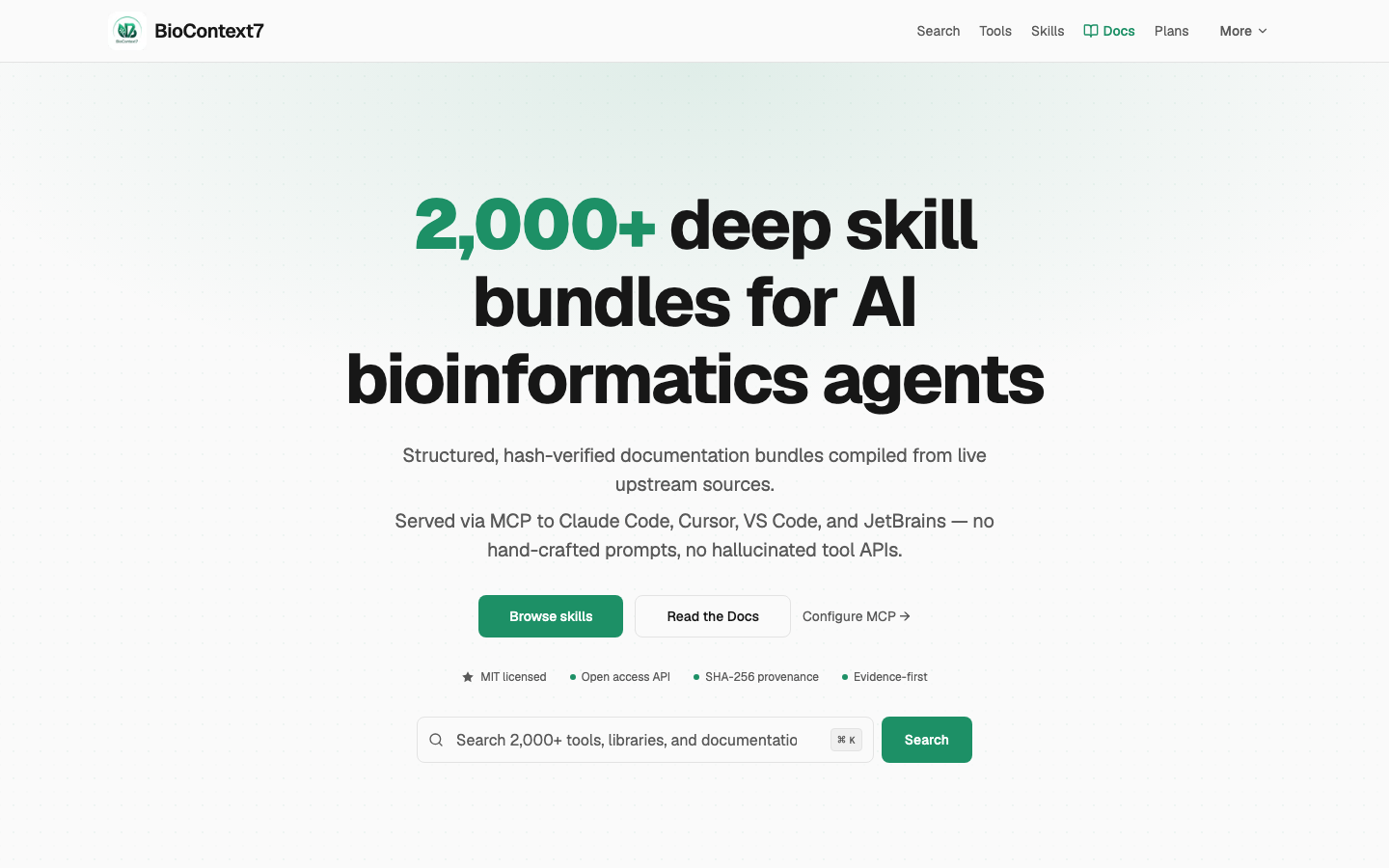
biocontext7

2,064 deep skill bundles for AI bioinformatics agents. Structured, hash-verified documentation bundles compiled from live upstream sources and served via MCP to Claude Code, Cursor, VS Code, and JetBrains — no hand-crafted prompts, no hallucinated tool APIs.

2,063

Deep skills

2,062

Tools with docs

537K+

Doc snippets

50+

Execution-certified

MIT licensed SHA-256 provenance Evidence-first Open access API

Served via MCP to Claude Code · Cursor · VS Code · JetBrains

biocontext7.com Open ↗
biocontext7.com — 2,000+ deep skill bundles for AI bioinformatics agents

Flagship product · biocontext7.com · served live

Two ways to engage

Collaborate with us on rare variant, CRISPR, or autoimmune research — or try the flagship product that researchers use every day.